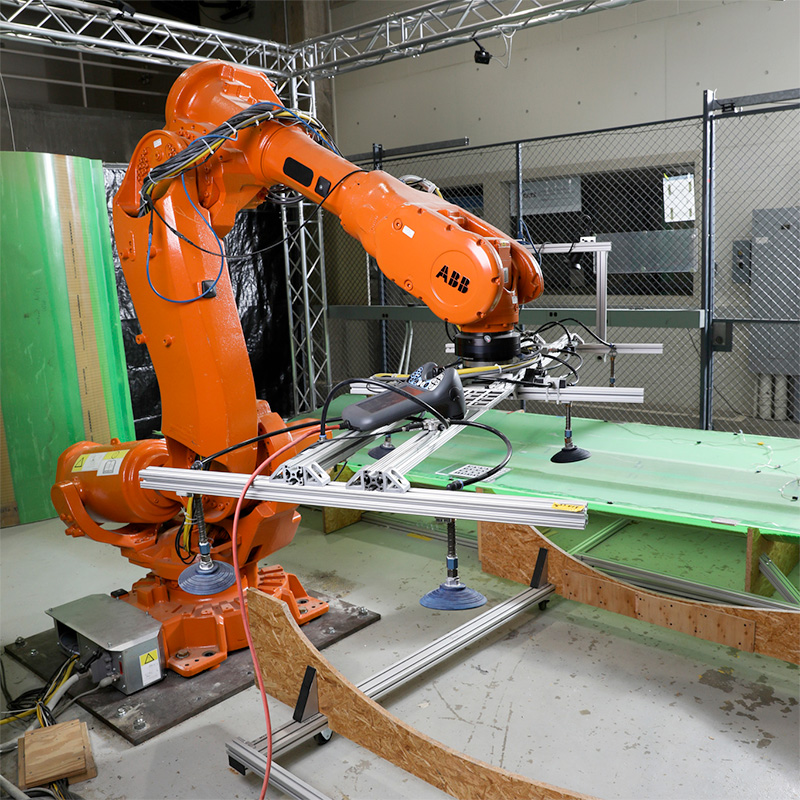
Founded in 1988 as part of the New York State Centers for Advanced Technology program, the Center for Automation Technologies and Systems (CATS) at Rensselaer Polytechnic Institute provides a means for industry to utilize an extensive pool of knowledge and expertise in the science and technologies of automation.
Rensselaer CATS leverages nearly 50 faculty members across 9 departments and 3 schools, plus full-time, dedicated research staff, to help its partner companies develop system-level solutions for high-impact, advanced-manufacturing challenges across a broad array of industries — from biotech and renewable energy to aerospace and nanoscale manufacturing — following a proven university-industry collaboration model to deliver technology-based economic development.
CATS' TECHNOLOGY FOCUS
The CATS technology focus is advanced manufacturing, centered on automation — autonomous algorithms, processes, systems and devices that improve efficiency, increase productivity, or provide new functionality. Automation is poised to become the enabling technology of the new global economy, creating and expanding competitive advantage to drive economic development and job creation.
CATS' CORE APPLICATION AREAS
Rensselaer CATS focuses its research efforts in four automation application areas: manufacturing, precision, design, and information automation — serving companies that span key industrial sectors, including manufacturing, energy, biotechnology, semiconductors, aerospace and defense. The Center’s research in each of these application areas is anchored by a common, holistic approach — a system-level design methodology that integrates modeling, optimization, sensing, and control. This intellectual foundation to problem solving facilitates development of generalized toolsets, tailoring them to specific applications and needs.
THE CATS MISSION
Rensselaer CATS conducts cutting-edge, industrially relevant research in advanced automation and control systems to advance knowledge, develop new technologies, foster economic growth and engender a richer, more relevant educational experience through collaborative partnerships among its public sector stakeholders, industrial clients, faculty, staff, and students.